
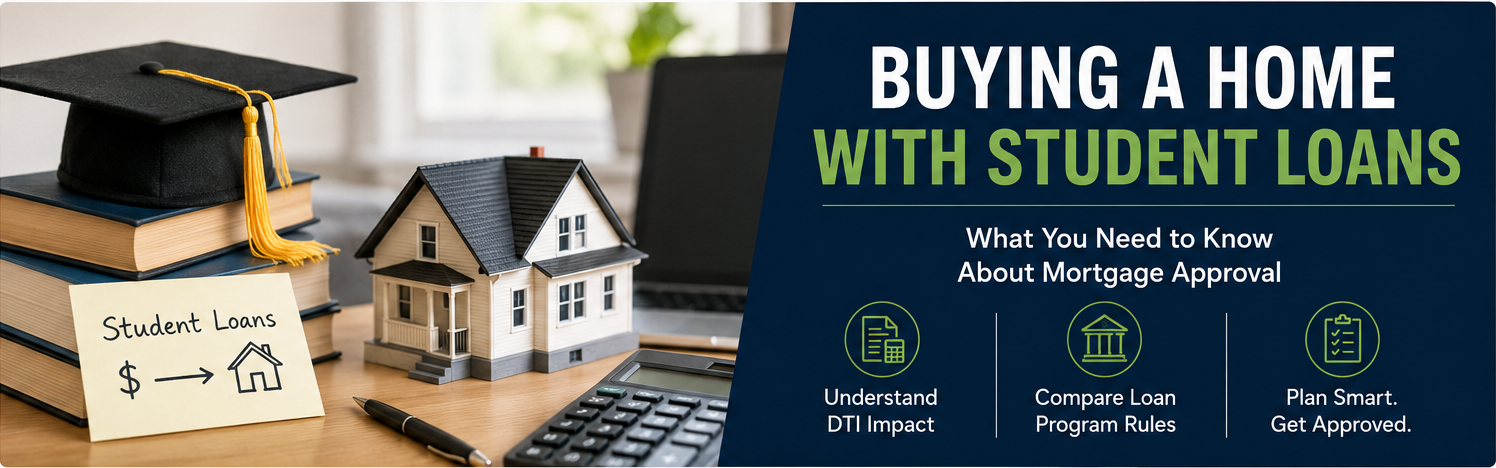
Yes, you may be able to buy a house while carrying student loan debt. Student loans do not automatically disqualify you from getting a mortgage. However, your monthly student loan obligation can affect your debt-to-income ratio, borrowing power, mortgage options, and the amount of home you may qualify to purchase.
The important detail is that mortgage programs do not always treat student loans the same way. Fannie Mae, Freddie Mac, Federal Housing Administration (FHA), and U.S. Department of Veterans Affairs (VA) guidelines can differ when a student loan is deferred, in forbearance, or on an income-driven repayment plan.
Understanding those differences before getting pre-approved can help you avoid surprises and better understand which mortgage options may fit your financial situation.
Key Takeaways
- Student loan debt does not automatically prevent you from buying a home.
- Lenders consider your student loan obligation as part of your overall debt-to-income ratio.
- FHA, Fannie Mae, Freddie Mac, and VA loans may calculate student loan obligations differently.
- A documented income-driven repayment payment may receive different treatment depending on the mortgage program.
- Comparing mortgage programs before applying can help identify an option that fits your complete financial profile.
Not sure how your student loans affect your mortgage options? A mortgage professional can review your documented payment, debt-to-income ratio, income, credit, and available loan programs before you begin home shopping. Contact My Easy Mortgage to discuss your situation.
Do Student Loans Affect Buying a House?
Student loans can affect buying a house because they are generally considered when a lender evaluates your monthly financial obligations.
The lender does not look only at the total amount you owe. Your documented monthly payment, repayment status, credit history, income, assets, other debts, and selected mortgage program can all influence the underwriting decision.
Student loan debt can affect your mortgage application in several ways.
Student Loans Can Increase Your Debt-to-Income Ratio
Your debt-to-income ratio compares your recurring monthly debt payments with your gross monthly income. A higher student loan payment can increase your DTI and potentially reduce the mortgage amount for which you qualify.
Payment History Can Affect Your Credit Profile
Your student loan payment history may appear on your credit report. Late payments, delinquency, collections, or default can negatively affect your credit profile and may make mortgage qualification more difficult.
Learn more about how credit can affect your mortgage options.
Student Loans Can Affect Your Borrowing Power
Even when you have strong income and credit, a higher monthly student loan obligation may leave less room for a future housing payment. This can affect your maximum eligible mortgage payment and overall homebuying budget.
The important point is that mortgage qualification involves your complete financial picture. Two borrowers with the same student loan balance may receive different qualification results because their monthly payments, incomes, credit profiles, assets, other debts, and selected mortgage programs are different.
How Lenders Factor Student Loans Into Your DTI
Your debt-to-income ratio, or DTI, compares your monthly debt obligations with your gross monthly income.
Student loan obligations can contribute to that calculation, but the qualifying amount may vary depending on the mortgage program, repayment status, credit report, and documentation available to the lender.
The basic DTI formula is:
Total monthly debt payments ÷ gross monthly income × 100
For example, consider a borrower with:
- $6,000 in gross monthly income
- $300 in student loan payments
- $400 in car payments
- $100 in minimum credit card payments
- $1,800 in estimated monthly housing expenses
The total monthly debt would be $2,600.
$2,600 ÷ $6,000 × 100 = 43.3% DTI
The lender would then evaluate that DTI along with the selected mortgage program, credit profile, assets, reserves, automated underwriting findings, and other qualification factors.
There is not one universal DTI limit that applies to every borrower or every mortgage program.
If a credit report shows a $0 student loan payment, a lender may or may not be able to use zero for mortgage qualification. The treatment depends on the applicable mortgage program and supporting documentation.
This is why borrowers with student loans should confirm which qualifying payment will be used before estimating how much home they may be able to afford.
You can also learn more about how mortgage affordability is calculated.
How Mortgage Programs Calculate Student Loan Payments
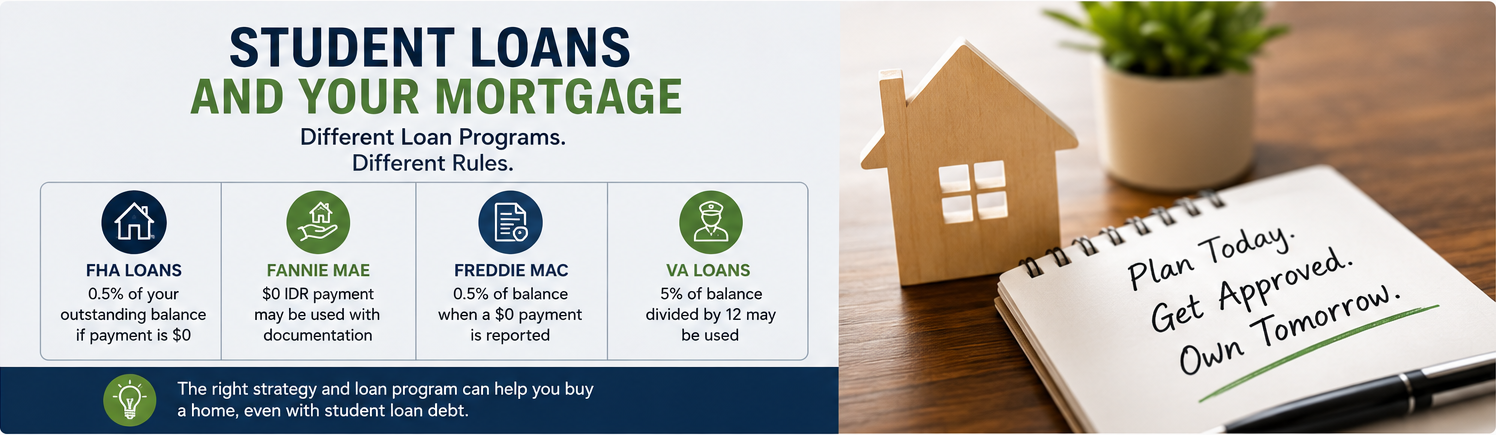
FHA, Fannie Mae, Freddie Mac, and VA loans do not always calculate student loan debt in the same way. These differences can have a meaningful effect on a borrower's DTI.
| Mortgage Program | General Treatment of Student Loan Debt |
|---|---|
| FHA | May use the reported or documented payment when applicable. When the reported monthly payment is $0, current FHA guidance generally requires a calculated payment based on the outstanding balance. |
| Fannie Mae | May permit a documented $0 income-driven repayment payment in qualifying circumstances. Deferred or forbearance loans without an applicable payment may require another calculation. |
| Freddie Mac | Requires a qualifying student loan payment greater than $0 to be included in DTI, subject to current Freddie Mac documentation and calculation requirements. |
| VA | Uses separate qualifying rules and may exclude certain deferred student loan obligations when specific VA requirements are satisfied. |
Mortgage guidelines can change, and individual lenders may also have additional requirements. Your loan officer should confirm the current guideline that applies to your mortgage application.
FHA Loans and Student Loan Debt
FHA loans follow specific student loan calculation rules established by the Federal Housing Administration.
Under current FHA guidance, when the monthly student loan payment reported on the credit report is above $0, the lender may generally use the reported payment or another appropriately documented payment.
When the reported monthly payment is $0, FHA guidance generally requires the lender to use 0.5% of the outstanding student loan balance as the monthly obligation.
For example, if the outstanding student loan balance is $60,000:
$60,000 × 0.5% = $300 per month
This is a mortgage underwriting calculation. It does not mean the borrower actually owes a $300 student loan payment each month.
Borrowers considering this option can learn more about FHA loans from My Easy Mortgage.
For current FHA policy, refer to the HUD Single Family Housing Policy Handbook 4000.1.
Fannie Mae Conventional Loans
Fannie Mae's conventional mortgage guidelines can provide different treatment depending on how the borrower's student loan payment is documented.
Under current Fannie Mae student loan guidelines, a lender may generally use the monthly payment shown on the credit report.
If the credit report does not accurately reflect the borrower's monthly payment, the lender may be able to use documentation from the student loan servicer showing the actual required payment.
Can Fannie Mae Use a $0 Student Loan Payment?
If a borrower is on an income-driven repayment plan and documentation verifies that the actual required monthly payment is $0, Fannie Mae may permit the lender to use $0 as the qualifying student loan payment.
A $0 amount appearing on a credit report by itself may not provide sufficient documentation. The lender may need documentation verifying the borrower's current repayment plan and required payment.
How Does Fannie Mae Calculate Deferred Student Loans?
For deferred loans or student loans in forbearance where an applicable monthly payment is not available, Fannie Mae may require the lender to use either:
- 1% of the outstanding student loan balance, or
- A fully amortizing payment based on documented repayment terms.
The appropriate calculation depends on the documentation and current underwriting guidelines.
Learn more about conventional mortgage options available through My Easy Mortgage.
Freddie Mac Conventional Loans
Fannie Mae and Freddie Mac are both associated with conventional mortgages, but their student loan guidelines should not be treated as identical.
Under current Freddie Mac guidance, a student loan payment greater than $0 must generally be included in the borrower's monthly DTI calculation.
The qualifying amount can depend on the payment shown on the credit report, student loan documentation, repayment status, and applicable Freddie Mac requirements.
This distinction matters because a borrower evaluated under Fannie Mae guidelines may receive a different student loan calculation from a borrower evaluated under Freddie Mac guidelines.
VA Loans and Student Loan Debt
VA loans follow student loan rules established by the U.S. Department of Veterans Affairs.
When documentation shows that a student loan will remain deferred for at least 12 months beyond the anticipated closing date, VA guidelines may allow the obligation to be excluded from the loan analysis.
If repayment has already started or is scheduled to begin within 12 months after closing, the lender generally must account for the student loan obligation according to VA requirements.
VA guidance includes a calculation based on 5% of the outstanding balance divided by 12 months, along with additional rules governing when another documented monthly payment may be used.
For example, using the 5%-divided-by-12 calculation on a $60,000 balance:
$60,000 × 5% ÷ 12 = $250 per month
The actual qualifying treatment depends on the borrower's documentation and applicable VA requirements.
Can You Qualify With a $0 Income-Driven Repayment Payment?
Possibly. A documented $0 income-driven repayment payment can receive different mortgage treatment depending on the loan program.
Under current Fannie Mae guidance, a properly documented $0 required payment under an income-driven repayment plan may be used for mortgage qualification in qualifying circumstances.
Other mortgage programs may require a calculated student loan obligation even when the credit report shows $0.
Do not assume that a payment displayed as $0 on your credit report will automatically be treated as $0 during underwriting.
A lender may request:
- A recent student loan statement
- Documentation of your repayment plan
- Confirmation of your required monthly payment
- Your outstanding student loan balance
- Evidence of deferment or forbearance
- Information about upcoming repayment or recertification
- Fully amortizing repayment terms when applicable
The mortgage program can change the calculation. My Easy Mortgage can compare conventional, FHA, VA, and other available mortgage options based on your documented student loan obligation and complete financial profile.
What If Your Student Loans Are Deferred or in Forbearance?
Deferred or forbearance status does not automatically mean that a mortgage lender can ignore your student loan debt.
Even when no payment is currently due, mortgage programs may require the lender to calculate a qualifying monthly obligation.
The calculation can vary among Fannie Mae, Freddie Mac, FHA, and VA loans.
Before applying, consider gathering documentation showing:
- Your current student loan status
- The outstanding balance
- The scheduled repayment date
- The expected monthly payment
- The length of the deferment or forbearance
- Your current repayment-plan terms
Providing this documentation early can help your mortgage professional determine which calculation applies and reduce potential underwriting delays.
Can You Buy a House With Student Loans in Default?
Buying a home with student loans in default may be more difficult. The effect depends on the type of student loan, credit history, selected mortgage program, and current status of the debt.
Default may affect:
- Your credit profile
- Your payment history
- Eligibility for certain government-backed mortgage programs
- Federal debt checks
- Collections or judgments
- The mortgage options available to you
Borrowers with defaulted federal student loans may need to address the debt before becoming eligible for certain mortgage programs.
If you have student loans in default, consider speaking with your student loan servicer and a mortgage professional before beginning your home search.
Strategies for Buying a Home With Student Loans
Student loans are only one part of your overall mortgage profile. The following steps may help you better prepare for mortgage qualification.
Document Your Current Student Loan Payment
Make sure you have recent documentation showing your current repayment plan, balance, and required monthly payment.
If you are already enrolled in an income-driven repayment plan, your documented payment may receive different treatment depending on the mortgage program.
Do not change your student loan repayment plan solely because you assume it will improve mortgage qualification. Repayment changes can have broader financial consequences and should be evaluated based on your complete circumstances.
Compare Mortgage Programs
FHA, Fannie Mae, Freddie Mac, and VA loans can calculate student loan obligations differently.
Comparing appropriate mortgage options may help identify a program that better fits your income, credit, student loan payment, available funds, and homebuying goals.
Review Other Monthly Debts
Reducing a debt with a relatively high monthly payment may improve your DTI more than making the same dollar payment toward a much larger debt with a smaller required monthly payment.
Before moving significant funds or paying off debt, ask your mortgage professional to evaluate how the change could affect qualification.
Review Your Credit Reports
Check your credit reports for incorrect student loan balances, duplicate accounts, outdated payment amounts, or inaccurate delinquency information.
Correcting legitimate errors before applying may help prevent unnecessary underwriting issues.
Avoid Taking on New Debt
New auto loans, personal loans, credit cards, and financed purchases can increase your monthly debt obligations and affect your DTI.
If you are already preparing to buy a home, discuss significant new borrowing with your loan officer before taking on additional debt.
Build Savings and Reserves
In addition to your down payment and closing costs, maintaining savings can help prepare you for moving expenses, repairs, and other costs associated with homeownership.
Get Pre-Approved Before Shopping
A mortgage pre-approval can help determine:
- Which student loan payment the lender may use
- Which mortgage programs may be available
- Your estimated borrowing range
- Your expected monthly housing payment
- Which documents may be required
- Potential qualification issues to address before making an offer
Work With a Mortgage Professional Who Understands Student Loan Guidelines
Student loan calculations are not identical across every mortgage program.
My Easy Mortgage can review your student loan documentation alongside your income, credit, assets, other debts, and homebuying goals to help determine which mortgage options may be appropriate for your situation.
Documents to Prepare Before Applying
Preparing documents early can make the pre-approval and underwriting process more efficient.
You may need:
- Recent student loan statements
- Repayment-plan documentation
- Documentation of your required monthly payment
- Deferment or forbearance documentation
- Recent pay stubs
- W-2 forms
- Tax returns when required
- Bank and investment statements
- Identification
- Employment information
- Documentation for additional income
- Statements for other debts
- Information about available funds for the down payment and closing costs
Your lender may request additional documentation depending on your mortgage program, employment type, income structure, credit profile, and student loan status.
Buying a Home With Student Loans in Tampa Bay
For borrowers buying in Tampa Bay, student loan debt should be considered as part of the complete homebuying budget rather than viewed in isolation.
Housing expenses can include the mortgage payment, property taxes, homeowners insurance, potential flood insurance, homeowners association fees, and other property-related costs.
Your student loan obligation must be evaluated alongside these expenses when determining an appropriate homebuying budget.
Whether you are buying in Tampa, Wesley Chapel, Land O' Lakes, or another Florida community, getting pre-approved before viewing homes can help establish a more realistic price range.
My Easy Mortgage works with first-time homebuyers, repeat buyers, and borrowers with a variety of income and debt profiles.
Frequently Asked Questions
Can I Buy a House if I Have Student Loan Debt?
Yes. Student loan debt does not automatically prevent you from qualifying for a mortgage. Lenders evaluate your student loan obligation alongside your income, credit profile, assets, other debts, proposed housing payment, and mortgage program.
Do Student Loans Affect How Much Mortgage I Can Qualify For?
They can. A higher qualifying student loan payment can increase your debt-to-income ratio and potentially reduce the mortgage payment or loan amount for which you qualify.
How Do Lenders Calculate Student Loans With a $0 Payment?
The calculation depends on the mortgage program, repayment status, credit report, documentation, and current underwriting guidelines. Some programs may permit a documented $0 payment in qualifying circumstances, while others require a calculated payment.
Can I Get an FHA Loan With Student Loan Debt?
Potentially, yes. Having student loan debt alone does not automatically disqualify you from FHA financing. The lender must include the appropriate student loan obligation when evaluating your DTI and complete mortgage application.
Can Deferred Student Loans Be Excluded From My DTI?
Not automatically. Many mortgage programs still require a qualifying payment for deferred student loans. Certain VA scenarios may permit exclusion when the deferment extends sufficiently beyond closing and all applicable VA documentation requirements are satisfied.
Does Fannie Mae Allow a $0 Student Loan Payment?
Under current Fannie Mae guidelines, a lender may use a documented $0 monthly payment when the borrower is on an income-driven repayment plan and acceptable documentation confirms that $0 is the actual required payment.
How Does Fannie Mae Calculate Deferred Student Loans?
If an applicable monthly payment is not available for a deferred student loan or loan in forbearance, current Fannie Mae guidance permits the lender to use either 1% of the outstanding balance or a fully amortizing payment based on documented repayment terms.
Should I Pay Off Student Loans Before Buying a House?
Not necessarily. Whether paying down student loans makes sense depends on your monthly obligations, available savings, mortgage program, other debts, financial goals, and complete mortgage profile.
Before using significant savings to pay down debt, consider asking a mortgage professional to compare how different options could affect your qualification.
Should I Get Pre-Approved if I Have Student Loans?
Yes. Pre-approval can help identify which student loan payment will be considered, which mortgage programs may be available, and how your student loan debt fits into your overall homebuying budget.
Student Loans Do Not Have to End Your Home Search
Student loan debt can affect mortgage qualification, but the total balance does not tell the entire story.
Your required monthly payment, repayment status, credit profile, income, assets, other debts, documentation, and selected mortgage program all matter.
Most importantly, Fannie Mae, Freddie Mac, FHA, and VA guidelines do not treat every student loan situation identically.
Instead of assuming student loans prevent you from buying a home, find out how your loans would actually be evaluated as part of a mortgage application.
My Easy Mortgage can review your student loans as part of the mortgage pre-approval process and help you understand the home-purchase options that may fit your financial situation.
Wesley Chapel Office
2405 Creel Lane, Suite 102
Wesley Chapel, FL 33544
Land O' Lakes Office
16703 Early Riser Avenue, Suite 266
Land O' Lakes, FL 34638
Call (813) 513-9846 or contact My Easy Mortgage to discuss your mortgage needs and begin your mortgage review.
Mortgage guidelines, student loan repayment programs, and qualification requirements can change. Loan approval depends on the borrower's complete financial profile, selected mortgage program, lender requirements, property, documentation, and underwriting review. This article is provided for general educational purposes and does not guarantee mortgage qualification or approval.




